


The insect in question is a beetle, the Ladybird beetle, Hippodamia convergens
being commonly available. As with other beetles, the ladybug has hard shells
evolved to cover the flight wings below. With such protection, the ladybug
can maneuver at the ground or plant level, walking around
without the danger of damaging the wings. Once in flight, the ladybug
can move around a garden easily.
The ladybug is prized in gardens because it is a predator for aphids. Occasional vendors will make claims that the ladybug will also control mites, eggs of other harmful insects, and such, but their effectiveness in those areas is not certain. Against the soft bodies of aphids, the ladybug is an awesome form of Integrated Pest Management, a case of insect controlling insect.
Life cycle
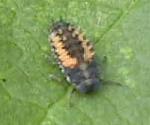 Ladybugs hatch from eggs laid by the adult females on the upper surfaces of
leaves. They are in a larval stage, with the larvae appearing as black,
alligator shaped bugs with orange markings. Unless you recognize this
stage of the ladybug's life, you may be concerned upon sighting these
larvae on your plants, and may want to attack them as a 'pest'!
Even at this stage, the ladybug consumes hundreds of aphids as available.
After 21 days of this immature stage, they pupate and adults emerge in 2-5
days, completing the cycle.The adult beetles, orange/red
with black spots, will then control aphids for the remainder of that year.
Ladybugs hatch from eggs laid by the adult females on the upper surfaces of
leaves. They are in a larval stage, with the larvae appearing as black,
alligator shaped bugs with orange markings. Unless you recognize this
stage of the ladybug's life, you may be concerned upon sighting these
larvae on your plants, and may want to attack them as a 'pest'!
Even at this stage, the ladybug consumes hundreds of aphids as available.
After 21 days of this immature stage, they pupate and adults emerge in 2-5
days, completing the cycle.The adult beetles, orange/red
with black spots, will then control aphids for the remainder of that year.
Sources
Ladybugs are readily available to the gardener from both catalog sources and
local garden stores. Quantities of purchase can range from 1/2 pint containers
(3500 to 4500 beetles) to 1 gallon containers (70,000 beetles). Buying such a
large quantity of ladybug adults is not a problem, since they can be easily
stored, applied over time, and many more are dispersed than will remain in a
garden to do their work.
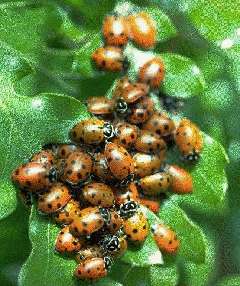
Ladybugs are raised by growers, or harvested from hollow trees in the
western mountain areas where they collect in late Summer to remain until
the following Spring. Hundreds of gallons of adult beetles are collected at
these sites.
As will be noted on the purchased container, there will be a number of beetles found dead on arrival. The container is packed with slightly moist excelsior or other loose material which harbors the beetles during shipment. This author once purchased a container of 3500 ladybugs, which yielded only 10 survivors! Hopefully, your vendor will handle fresh containers and store them properly.
 Storage
Given that the large number of ladybugs in a container should be applied
to the garden over a period of time, it is fortunate that storage is easy.
Keeping the container in the fresh food compartment of a refrigerator
provides the 35-45 degree F range to keep the beetles alive but limited in
activity. The packing material inside the container should be LIGHTLY dampened
once every few weeks during storage. For ladybugs shipped to you before
May, the container can be stored up to the beginning of June. Containers
shipped late in the Spring can be stored several months with controlled
temperature.
Application
The one thing you do NOT want to do is
try the 'easy' application method:
dumping the contents of the container in your yard as a single application.
Ladybugs are a bit fickle; you'll find they all won't stay in your yard to
do their work! It has been estimated that up to 90% of the beetles released
will leave your yard - aren't you glad you bought 3,500?
There are several reasons ladybugs disperse rather than remaining at the
point of application. The beetles collected during Winter hibernation disperse
widely when the temperature is above 65 degrees F. Ladybugs collected
later in the year usually have stored energy in their bodies, and are less
inclined to search out aphids for a meal.
The best application scheme, considering the above, is to release your ladybugs in small amounts over a period of time. A convenient way to do this is to apply one teaspoon of beetles from the container to each plant in danger from aphids. The best time to apply the ladybugs is in the cool of the evening, after sprinkling the area with water important to the thirsty beetles. Releasing ladybugs in the warmth of sunlight will cause them to take flight and travel to perform their work in your neighbor's garden! Apply when the temperature is in the range 61-82 degrees F; ladybugs won't fly in temperatures 55 degrees F or lower. Repeat the application every 4 days or weekly, depending on the aphid problem. Each adult consumes about 5,000 aphids. Within 8 to 10 days of release each female ladybug lays 10-50 eggs daily on the underside of leaves.
Although their diet of aphids make the ladybug an ally to the gardener, these beetles also do well in areas with flowering, pollen-bearing plants. A selection of wildflowers will provide a diet supplement that will keep ladybugs in your garden, laying eggs to produce further generations of aphid-controllers.
Watch that insecticide!
Perhaps your decision to use ladybugs in your garden is not a part of a
totally organic, non-chemical pest management plan. Remember that the
insecticide applications in your yard will work against these beneficial
insects you have applied. You must keep in mind a balance considering
application of beneficial ladybugs, and the spot application of insecticides
(or systemics) only when necessary.
You can buy ladybugs locally, or through vendors such as:
Gardens Alive or The Green Spot