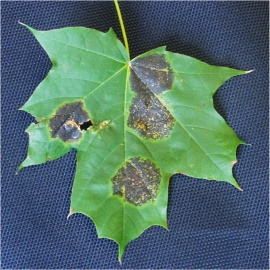
In 2003 Tar Spot of Norway Maples is a Rochester regional issue and this year is the worst we have ever seen. Some trees are now showing some defoliation. Fortunately since they are losing their leaves in late summer (the end of the season) the trees will be okay. The problem we are seeing now is related to the wet spring weather. It is unlikely that the conditions will be as favorable for this disease again next year. Below we have reproduced the excellent fact sheet from Cornell Cooperative Extension.

TAR SPOT FACTS

The level of incidence of this fungus disease of Norway Maples has increased in recent years, and is most serious in growing seasons in which the spring time weather is excessively rainy. The infections can only take place in the spring on expanding leaves and then the symptoms develop in late summer and early fall.

This disease does not threaten the overall health of the affected trees, however the highly visible spotting causes concern to many residents.

Cause and Symptoms

Affected leaf
  • The disease of Norway maples is caused by a fungus called Rhytisma acerinum.
  • In early summer, light colored yellowish spots appear; within these spots small black specks form.
  • By late summer to early fall these specks grow together to form dark black single lesions, and an individual lesion may reach an inch in diameter.
  • When the lesions occur on petioles (leaf stems) the leaves may fall prematurely.

Fungus Life Cycle

  • The fungus spends the winter within the dark black leaf lesions. At about the time of leaf emergence the fungus will release spores that can travel by air currents up to the newly developing Norway maple leaves.
  • The disease is worse in years when we have had a wet spring at the time of Norway Maple leaf expansion.
  • Although infection occurs only in this spring, symptoms do not begin to be noticed until the summer.

Control Measures

  • Even when defoliation occurs the overall health of the Norway Maple is not harmed.
  • Raking and removing fallen leaves with spots prior to leaf emergence this spring can help control this disease. Be aware that for this to be most effective it needs to be done on a community wide basis, and that vacant wooded areas often include self-seeded Norway Maples. These infected leaves can be composted, just be sure they are not on the surface of the pile where they would be free to release their spores.
  • In rare situations fungicides may be used to prevent this disease. However, since thorough spray coverage is important and most effected trees are located near highly populated areas, spray applications may not be practical. The fungicides mancozeb (sold as a product such as Protect T/O) and tridimefon (sold as a product such as Bayleton) have been proven effective. If used these fungicides will need to be applied at bud break and twice thereafter at 7 to 14 day intervals.
  • Studies are under way to determine if injectable fungicides, which skirt the drift problems, may be effective.
  • Any treatment to the tree after lesions/spots have formed will not improve the appearance of the leaves that season. Preventative fungicide application, if used, must be done in Spring.
Brian Eshenaur, Cornell Cooperative Extension

Following are some links to additional information and 2003 tar spot conditions:
Cornell University factsheet
Rochester Democrat & Chronicle - August 19, 2003
City of Rochester recommendation


[ Past Spotlight features ]... [ Rochester Gardening site map ]