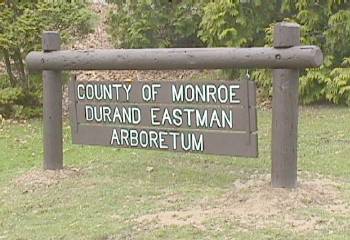
Durand-Eastman Park: Slavin's Arboretum
by Richard J. Cook
At the turn of the century, Dr. Henry S. Durand owned a summer camp in Irondequoit. He and
his friend George Eastman saw a need for a public park in the area, and towards this end, bought
a number of farms around the Durand property. On January 28, 1907, they offered their land to
the city of Rochester, "to be used as a public park forever, a tract of land of about 484 acres
situate in the Town of Irondequoit on Lake Ontario," thus giving the common citizen rights to
nearly a mile of public beach and adjacent lands on the Lake's shoreline. A year later the land
was transferred to the city, and on May, 22, 1909, Durand Eastman Park was formally dedicated.
While Durand and Eastman gave the people of Rochester a fine tract of land including some 75
acres of native woodlot, much of the rest was scrub farm land. The opening day ceremony
included the planting of two red oak (Quercus rubra) saplings, but the rest of the
Herculean task of clothing the sandy hills fell to an Irish immigrant, Bernard H. Slavin. Having
no formal higher education, Slavin began work in Highland Park in 1888, as a laborer. His
mentor there was John Dunbar, a Scottish immigrant who learned about horticulture on the estate
of the Duke of Argyle in England. Dunbar was Assistant Superintendent of Parks and largely
responsible for Highland's extensive lilac collection and "Lilac Sunday." In the teens, Slavin
worked at Harvard's Arnold Arboretum in Boston. While there, he learned the art of plant
propagation from the Arnold's English born plant propagator, Jackson Dawson.
 Slavin began work on Durand Eastman in 1908. Years later he quoted a member of the Park
Commission as saying, "I don't know why you bother with it, Barney. You'll never make
anything of it." Faced with limited funds, he established a nursery in the Park to house many of
the plantings. Seeds and cutting of exotic species came from overseas, Highland Park, and the
Arnold Arboretum. Collecting expeditions by Slavin and other park employees provided a
wealth of native species from the Appalachians and the Mid-west.
Slavin began work on Durand Eastman in 1908. Years later he quoted a member of the Park
Commission as saying, "I don't know why you bother with it, Barney. You'll never make
anything of it." Faced with limited funds, he established a nursery in the Park to house many of
the plantings. Seeds and cutting of exotic species came from overseas, Highland Park, and the
Arnold Arboretum. Collecting expeditions by Slavin and other park employees provided a
wealth of native species from the Appalachians and the Mid-west.
An arboretum is not just a park with trees, but a living collection of often exotic species laid out
with scientific study in mind. Many older arboretums, like the Arnold, follow a taxonomic plan
that attempts to show the evolutionary progression of the species within the collection. Highland
Park has many families of trees and their genera grouped together, but is arranged a little looser
in this respect than its older sister in Boston. In Durand-Eastman, Slavin moved even further
from this purely scientific theme. The result blends science with the land in an aesthetically
pleasing form. What all three arboretums do have in common are world class "pinetums,"
collections of coniferous trees.
Pine Valley is the heart of both Durand-Eastman's pinetum and the overall arboretum. It lies
between Zoo Road to the west and "Yew Hill' to the east, and its breadth is rather staggering.
There are multiple species of fir (Abies), spruce (Picea), pine (Pinus),
false cypress (Chamaecyparis), juniper (Juniperis), yew (Taxus),
arborvitae (Thuja), hemlock (Tsuga), Douglas fir (Psudeotsuga), dawn
redwood (Metasequoia),and cedar of Lebanon (Cedrus libani). This list does not
include cultivars or hybrids, of which there are many, and doubtless, there are many omissions.
In old photographs, the hillsides of Pine Valley are plainly visible; today the eye sees a valley of
evergreens bisected by a small stream and grassy commons. The scene changes seasonally, as
Slavin sprinkled deciduous trees throughout. Against a background of greens and shade,
specimens like the fragrant snowbell, Styrax obassia, and silverbell, Halesia
monticola, display their blooms. In mid-summer, sourwood, Oxydendrom
arboreum,blooms high amid the conifers and come October its leaves scream red against
green.
 |
Exceptional specimens of conifers here include four moss sawara, Chamaecyparis
pisifera 'squarrosa.' Their blue crowns erupt from the surrounding green upon massive trunks
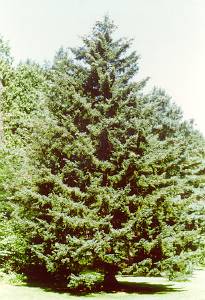
like the legs of some great beast. In the relative open of the Valley's center are sacalin
spruce, Picea glehnii, with their short needles and conical form. Nearby are maturing
dawn redwoods, Metasequoia glytostroboides, their lower trunks exhibiting a swollen,
rope appearance. The giant arborvitae, Thuja plicata, is used extensively on the east
slope of Zoo Road as "filler." Its russet bark is as soft to the hand as it is to the eye.
|
| Sacalin spruce |
Like a stone lion guarding the entrance to an oriental garden, a stately nikko fir, Abies
homolepis var. umbellata, stands over the trail into "Rhododendron Valley." This
small den off the east side of Zoo Road Hill is planted with members of the Ericaceae
family. These include: azalea, clethra, leucothoe, rhododendron and sourwood. In late June, the
mountain laurel, Kalmia latifolia, blooms. This acidphile is a rare sight in our area, as
most of Monroe County's soils are too limey for it. Also present is the giant dogwood,
Cornus controversa, very much like our own pagoda dogwood, C. alternifilia,
with its stratified branching.
on to page 2 >>>
[ Rochester Gardening home page ]
[ Past Spotlight features ]