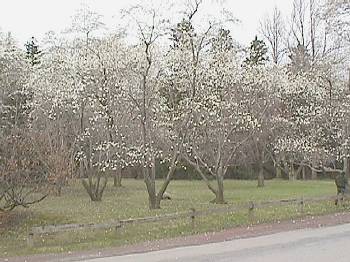
Magnolia x proctoriana
To the east of Pine Valley Road and south of Sweetfern, is "Yew Hill," named for the many Taxus species planted there, most of which came from the Geneva Experiment Station in 1938. It is amazing to see T. baccata that have attained their natural destiny as trees, as compared to their more common form as mere shrubs by someone's front door. There are many conifers of note here, including Dahurian larch, Larix gmelinii, dragon spruce, Picea asperata, Serbian spruce, P. omorika and ponderosa pine, Pinus ponderosa. Deciduous trees include a native relative of the magnolia, the tulip tree, Liriodendron tulipera. The trunk is a massive dark column, and the pale green and orange flowers vaguely resemble its namesake's, but the leaves also suggest a tulip's bloom. Not to be overlooked is the Korean maple, Acer pseudosieboldianum. This small tree turns a fine gold in the fall.
|
An Englishman named E.H. Wilson was a well known plant collector who sought out exotic species in western China for Veitch & Sons, the Arnold Arboretum, the USDA, and other institutions. His expeditions over eleven years brought the West something on the order of 1000 species and his name is immortalized in plant names like Rhododendron wilsonii. He secured seeds of species like the paper bark maple, Acer griseum and the dove tree, Davidia involucrata, which can be seen today in Durand-Eastman. A group of large specimens of the paper bark are found on the east side of Zoo Road, not far from the labor center. |
| Slavin's Snowy magnolia Magnolia x proctoriana |
The Oak Picnic Grove has some 50 large oaks of several species on the west side of Log Cabin Road. Other genera include bitternut and shellbark hickories, Carya cordiformis and C. laciniosa, two Florida natives, the Ogeechee tupelo, Nyssa ogeche, and the bald cypress, Taxodium distichum, several black birch, Betula lenta, with their wintergreen scented twigs and a lone specimen of the Japanese raisin tree, Hovenia dulcis. Beneath additional oaks on the east side of the road, is a small buckeye, Aesculus glabra var. arguta. Several anise magnolias, Magnolia sasisifolia, are on the eastern periphery. There were many Florida dogwoods, Cornus florida and Eastern redbuds, Cercis canadensis, that Slavin planted in large groups. In their day they were most effective, masses of color in spring and fall. Sadly, most of the former have succumbed to the Asiatic dogwood twig blight and what the ice storm of 1991 left of the latter are in an advanced state of senescence. Even trees die of old age.
At the southern end of Log Cabin Road between Pat Lake and Wisner Road is the Seyerle
property, named after its former owners. This site has been let go in recent years and is now
crowded with noxious woody weeds like Oriental bittersweet, mulitflora rose, and amur
honeysuckle. This site does host some interesting trees like the Korean mountain ash, Sorbus
alnifolia, with its silver bark and alder-like leaves. Acer mono and the eagle's claw
Norway maple, A. platanoides 'Laciniatum,' are planted on the hill. By the lake is the
native shrub false indigo, Amorpha fruiticosa, whose summer flowers are royal purple
and gold.
The Arboretum has another Oak Grove, located between Sunset Point and Horseshoe Roads.
These oaks form an impressive canopy, but there is a paucity of understory flowering species to
complement them. A few European beech, Fagus sylvatica, and the sweet gum,
Liquidambar styraciflua, are scattered in this grove. A maple native to the west coast, the
vine maple, Acer circinatum, grows along Sunset Point Road across from the picnic
shelters.
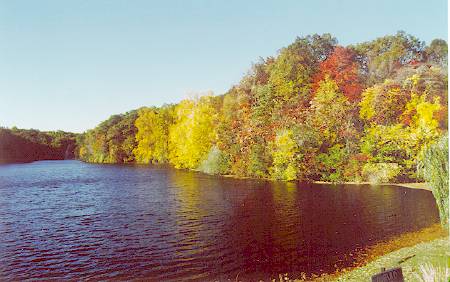
The beaked hazel, Corylus cornuta, and the American filbert, C. americana, are two often overlooked natives. They grow wild along the trails around Durand and Eastman Lakes. Members of the birch family, Betulaceae, they flower in late winter, the male catkins releasing their pollen on the breeze. The tiny reddish pistillate flowers are easily overlooked, but the fall foliage often speaks loudly. Tree hazels, Corylus corlurna, and Chinese chestnuts, Castenea mollissima, are planted along the eighteenth fairway of the golf course. In this area there are also a number of vernal witch hazels, Hamamelis vernalis, and Chinese witch hazels, H. mollis. Their flowers are a yellow haze through bare limbs in late winter. Tupelos, Nyssa sylvatrica, are planted in numbers here, their bright shiny green leaves transforming into an eye-catching red in the autumn.