|
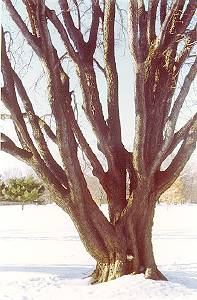
Across Kings Highway is the first fairway, with an euonymus row of tree proportions. This is the Chinese spindlewood, Euonymus bungeanus. Here, too, are the remnants of the elm family (Ulmaceae) collection that the Dutch elm disease left in its wake. Included is a Chinese elm, Ulmus parviflora, the exfoliating bark looking just like a sycamore's. There is a great specimen of the hackberry, Celtis occidentals. The leaf has an off-set base like its cousins the elms and selkovas, while the bark is gray and warty. This one rivals those in Genesee Valley Park that were damaged by the windstorm of 1998. |
| Hackberry Celtis occidentalis |
Horseshoe Road harbors two interesting native shrubs. The appropriately named bladdernut,
Staphlea trifolia, has a balloon-like seed capsule, within which are three seeds that can be
heard rattling around. A quick squeeze yields a satisfying "pop." The attractive compound leaves
have three parts. In the swamp, formerly the "Lily Pond," is a buttonbush, Cephalanthus
occidentalis. This wetland species often grows in a foot of black water. The globe-shaped
flowers appear in summer and attract hummingbirds.
On the west side of Kings Highway at Edgerton Road, Slavin planted approximately a dozen
American fringe trees, Chionanthus virginicus. Related to the ash and the lilac, these
shrub trees have airy white flowers in late May to early June. The foliage turns a fine yellow in
autumn and is accompanied by a grape-like fruit, a purple drupe. Considerable numbers of the
flame maple, Acer ginnala, were also used here and on other roadsides for fall effect.
Most have succumbed to old age. On the east side of Kings Highway, south of Edgerton Road, is
a group of compound leafed maples, A. cissfolia, native to Japan. The samaras hang
down in long corymbs and are very pretty. They are related to our own box elder maple, A.
nugundo.
Sweetfern Road is the Park's entrance from Culver Road. Near its east end are Eastern white pine, Pinus strobus, and persimmon, Diospyros virginiana. Japanese cornel trees, Cornus officinalis, flower in March, following the vernal witch hazels. Near the crest of the hill is the original type specimen of the crabapple 'Katherine,' Malus halliana X. It was a seedling found in the Park by Slavin, and named by Donald Wyman for Slavin's daughter- in-law, Catherine Clark Slavin. Part way down the hill is a great thicket of bottlebrush buckeye, Aesculus parviflora. This shrub blooms in July and August with showy white flowers. In October, the stand becomes a mass of yellow. In the woods nearby is a specimen of the mountain silverbell, Halesia monticola. It is most likely the largest in this part of the state.
North of the Park labor center on Zoo Road, the hillside is planted with many katsura trees, Cercidiphyllum japonicum. They are so well acclimated that they appear to be native. On the west side of the road is a line of red oaks, Quercus rubra, that mark the southern boundary of the former zoo. The small valley here is the Rose Valley, named for its collection of trees in the rose family. Pear, crabapples, juneberry and mountain ash struggle among the weeds. There was a plan to plant roses here in quantity to create a "Rose Bowl," but it never came about. South of Rose Valley is a poorly situated parking lot that bisects the Arboretum's magnolia collection. On the west edge of the hill is the "B" pinetum, and the fastigiate (columnar) tree collection. Here are limber pine, Pinus flexilis, and the Oriental spruce, Picea orientalis. Slavin had a passion for developing upright street trees, and planted fastigiate white and ponderosa pines, tulip, hickory, and sugar maples.
The magnolia collection is an interesting mix. At its north end are two species of timber
proportions, a native cucumber tree, Magnolia acumunata, and its Asian counterpart, the
Hakkaido magnolia, M. kobus var. borealis. The cucumber can be seen growing
wild in Letchworth State Park, and is used for lumber. The umbrella magnolia, M.
tripetala, and a great many named hybrids are in the central collection. Sadly, the tags at this
site are often destroyed by vandals.
With the magnolias are some of the park's most exciting deciduous trees. The Persian ironwood,
Parrotia persica, has exfoliating bark and rich fall foliage. There is a single specimen of
Evodia hupehensis, which has beech-like gray bark and is one of the last trees to bloom
in late summer. There is also a stand of Yeddo hornbeams, Carpinus turczaninovii, with
smooth, gray muscular trunks. At the south end of the magnolias is a lone witch hazel,
Hamamelis X 'superba,' developed by the Rochester Parks Department. The orange
flowers fill the winter air with a spicy scent in February.
| Slavin described the Chinese fringe tree, Chionanthus retusus, as a shrub, while E. H. Wilson proclaimed the davidia as the most beautiful flowering temperate tree. Perhaps they were both a little wrong. The pair of Chinese fringe trees in the midst of the magnolias look like great, billowing white clouds when they flower in mid-May. They live up to their genus epithet, derived from the Greek chion (snow) and anthos (mountain). There is another specimen growing by the old pump house on Eastman Lake, beneath the much maligned black walnut. | 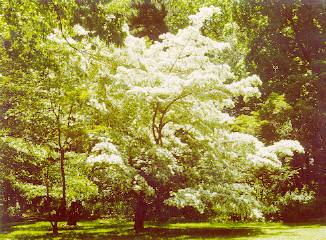 |
The author wishes to thank former park taxonomist James P. Kelly for sharing his enthusiasm for trees and for prompting him to learn their binomial names at an impressionable age.